
Indicant / Decision integrity for defense
Decision integrity for autonomous warfare
Indicant generates operational assessments and connects them to evidence and reasoning. Trace changes in their support to inform decisions as new information arrives.
Evidence, reasoning, and human judgment

01 / Generate an assessment
Generate assessments from the evidence
Indicant turns source footage and entity observations into situation assessments. Each conclusion stays connected to the evidence that supports it, with missing output, weak support, and unresolved identity visible.
How decision integrity works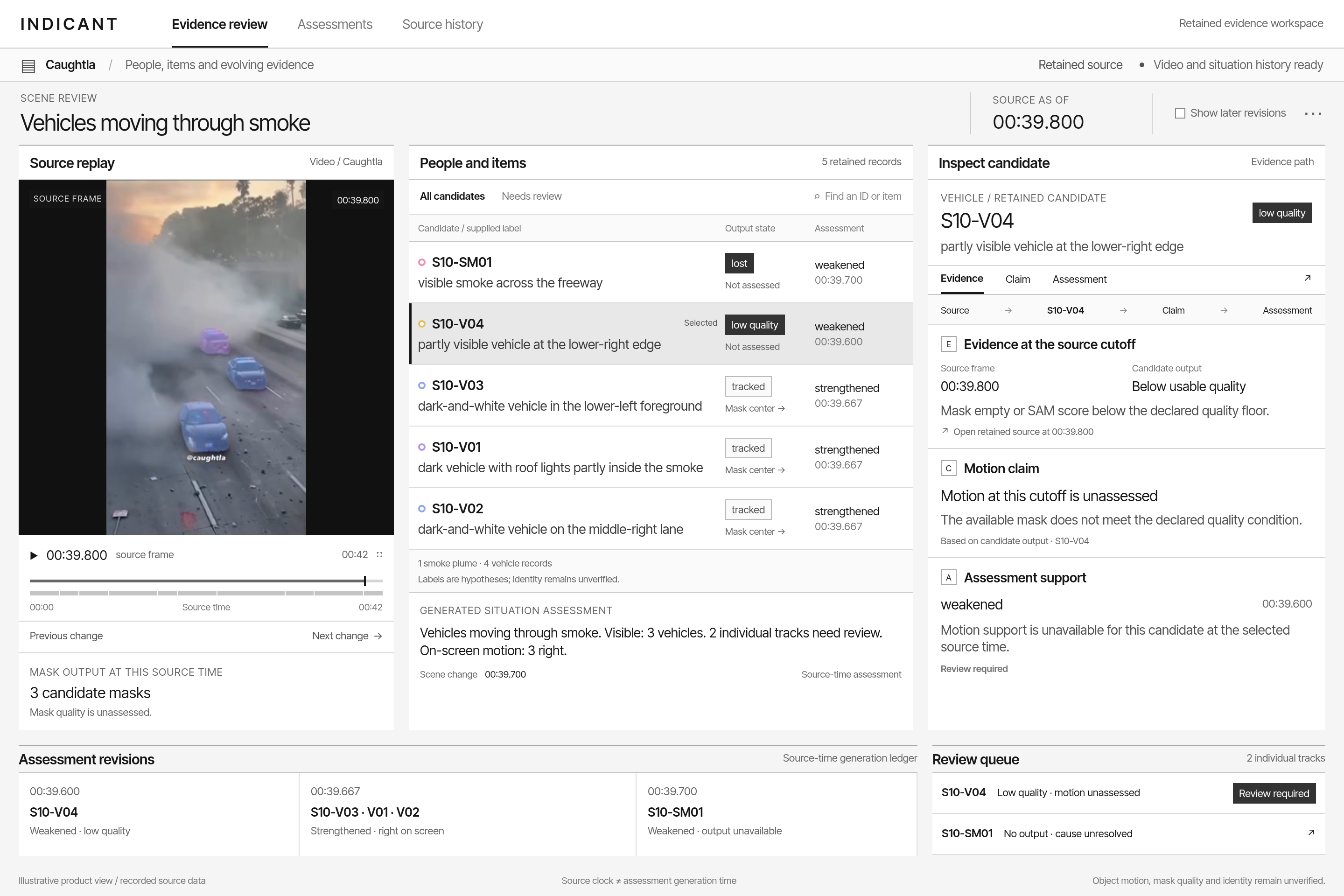
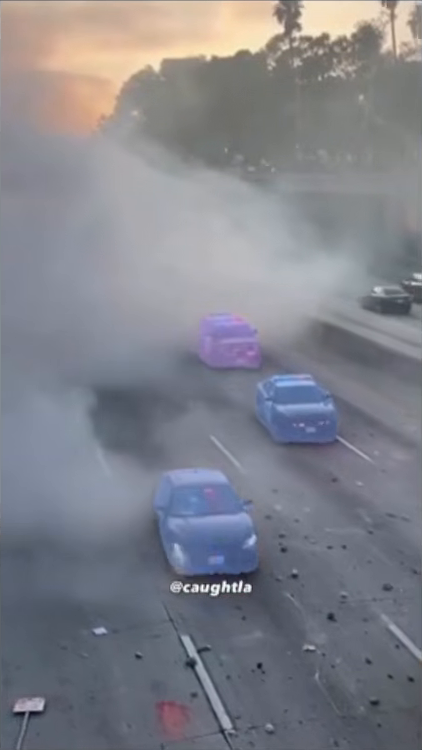
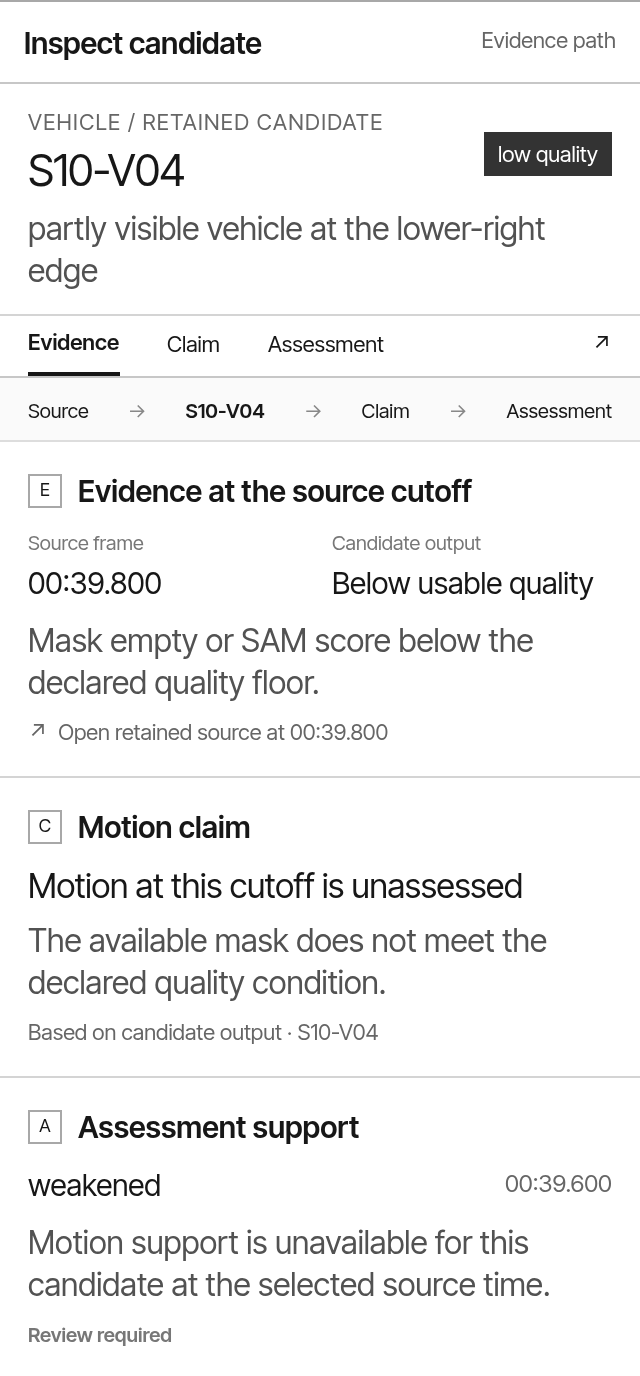
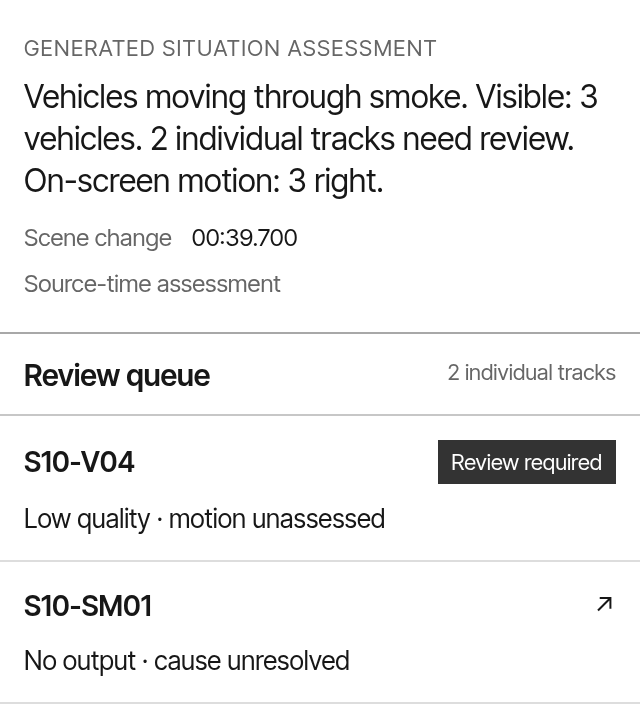
At source 00:39.800, Indicant generates a scene assessment from vehicle observations and their output states. Three vehicles retain screen-space motion support; missing and low-quality output remain explicit for two other candidates.
Open the complete workspace imageRead the evidence summary
- Source and scene assessment
- Source 00:39.800. The generated scene assessment reports three visible vehicles, two individual tracks needing review, and three mask centers moving right on screen.
- Separate review reasons
- S10-SM01 has no output at the selected source time; its assessment weakened at 00:39.700. S10-V04 is low quality because its mask is empty or its SAM score is below the declared quality floor; its assessment weakened at 00:39.600.
- Retained support
- S10-V03, S10-V01, and S10-V02 remain tracked. Their reported mask centers move right on screen, with assessments strengthened at 00:39.667.
- Scope of the observation
- Three candidate masks are shown at the selected source time. Mask quality, physical motion, and identity remain unverified. Candidate records, visible objects, and available masks have different scopes.
02 / Connect evidence to decisions
Keep decisions connected to their basis
Follow a conclusion through its claims to the source material. Compare competing explanations and see how later evidence changes support, while retaining what was known when the assessment was made.
Explore evidence and reasoning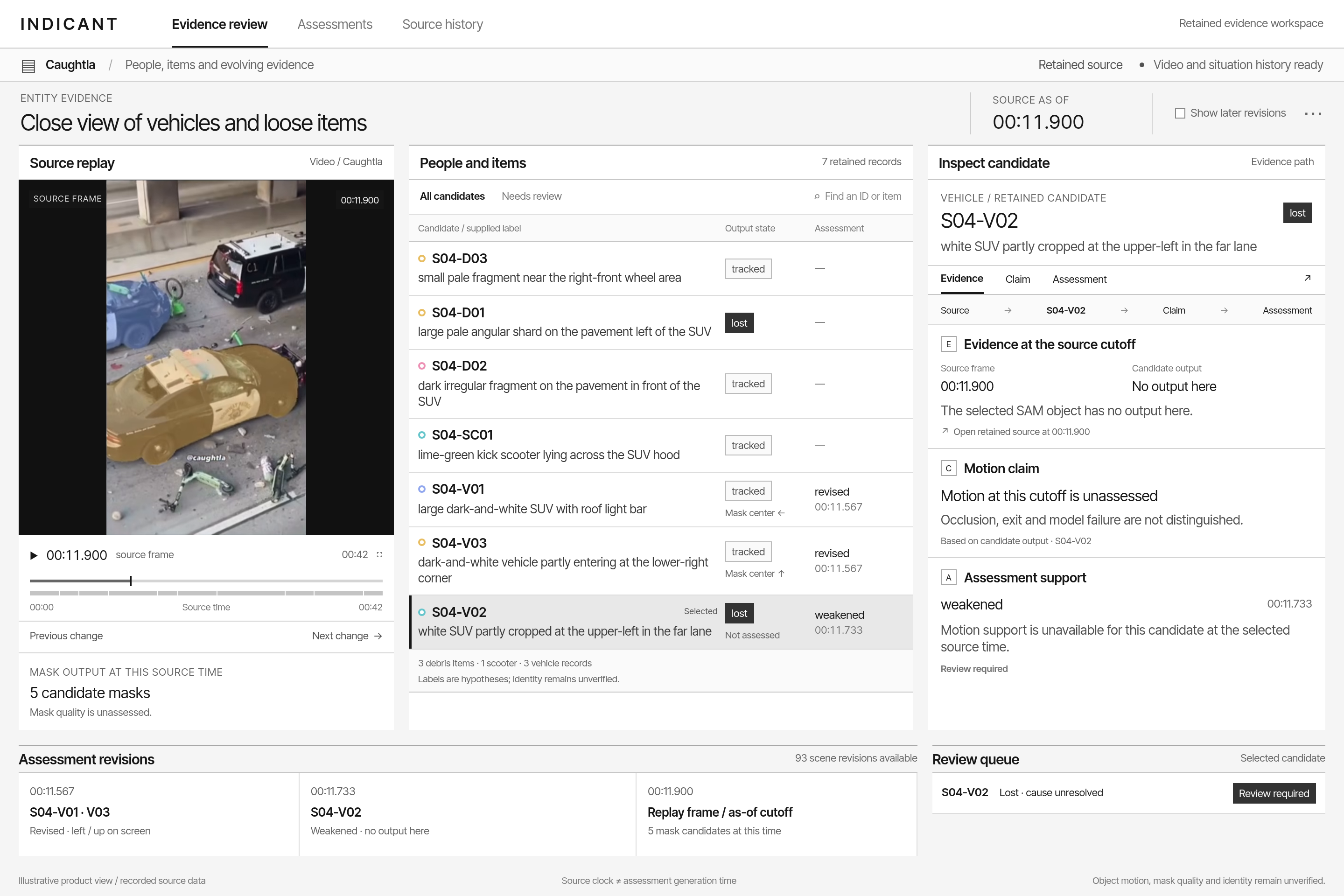
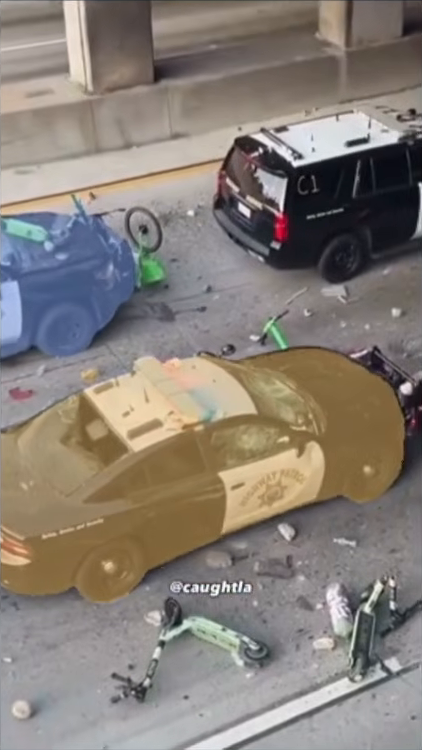
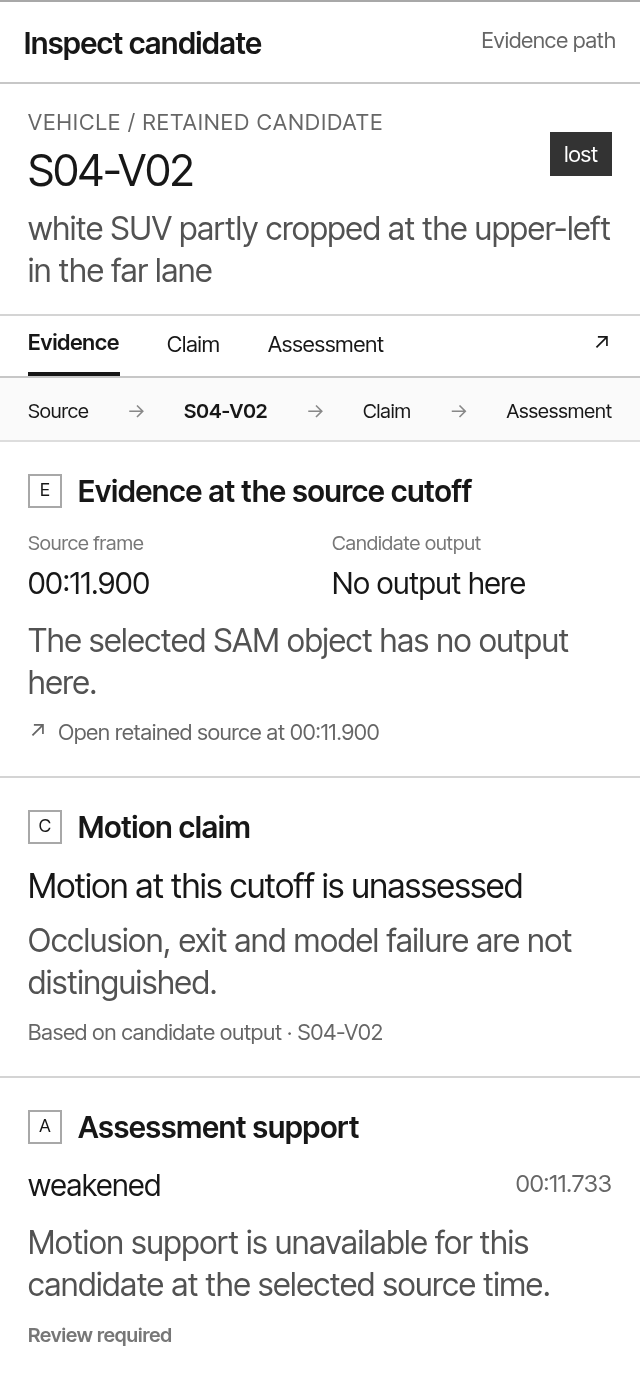
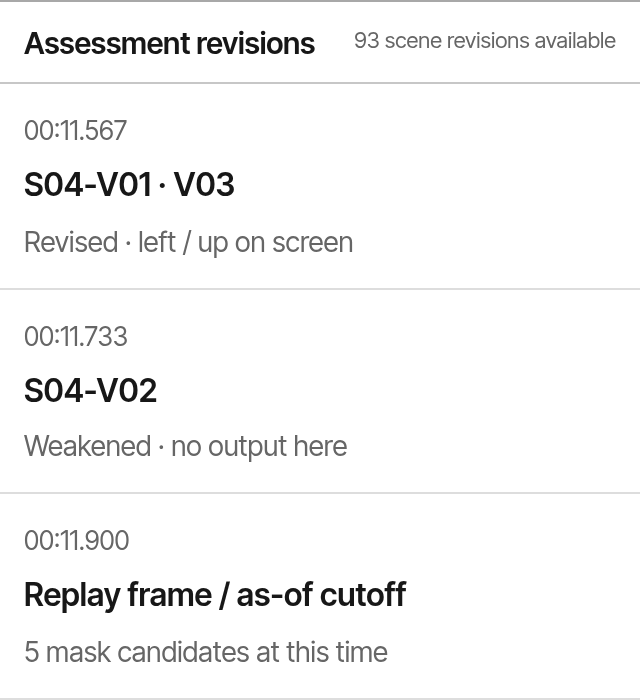
At source 00:11.900, S04-V02 has no output and its assessment has weakened. Inspect the recorded reason alongside the source frame and revision history; the cause of the missing output remains unresolved.
Open the complete workspace imageRead the evidence summary
The evidence behind a weakened assessment
- Selected candidate
- S04-V02 is the white SUV partly cropped at the upper-left in the far lane. At source 00:11.900 it is lost, with its assessment weakened at 00:11.733.
- Evidence, claim, and assessment
- The selected SAM object has no output at this source time. Occlusion, exit, and model failure are not distinguished, so the available output does not establish physical movement or disappearance.
- Context retained alongside the selection
- The register contains three debris candidates, one scooter candidate, and three vehicle candidates; five candidate masks and 93 available scene assessment revisions describe the separate scopes of output and retained history.
- Other supported observations
- S04-V01 has mask-center movement left on screen and S04-V03 has movement up, with both assessments revised at 00:11.567. S04-D01 is lost while S04-D03 and S04-D02 remain tracked.
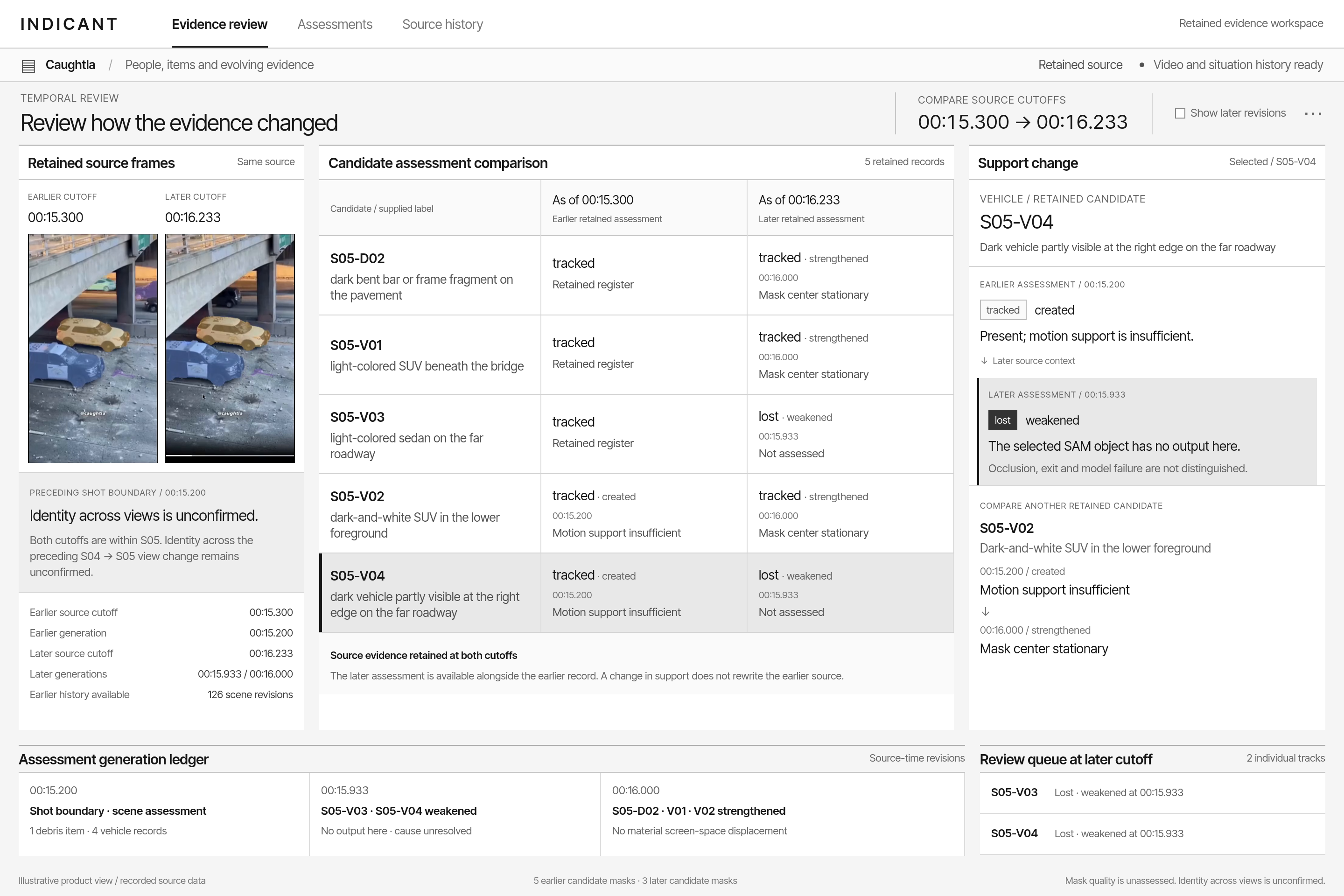
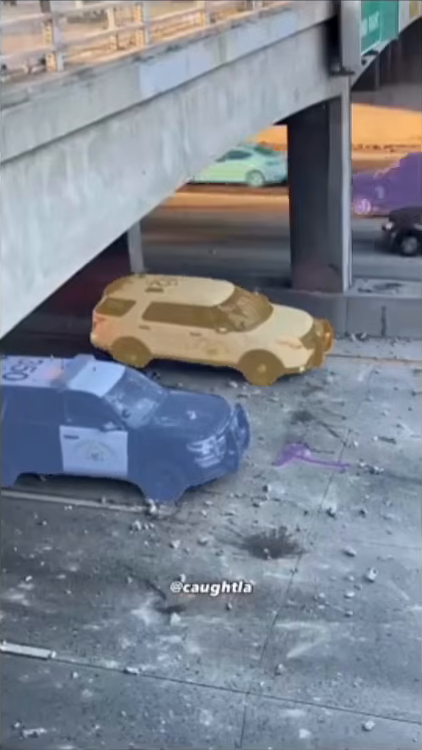
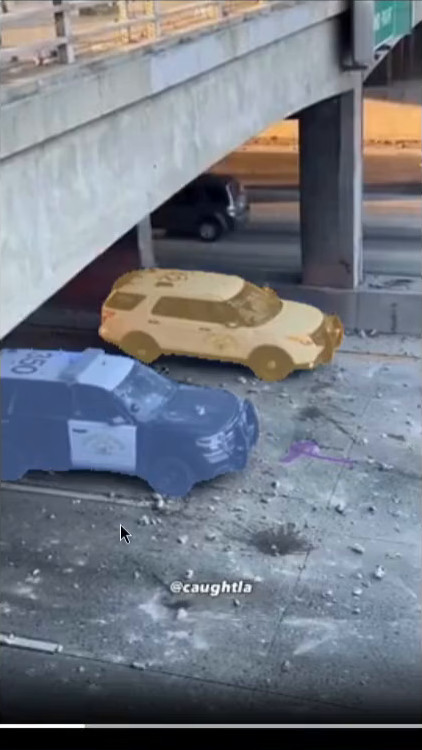
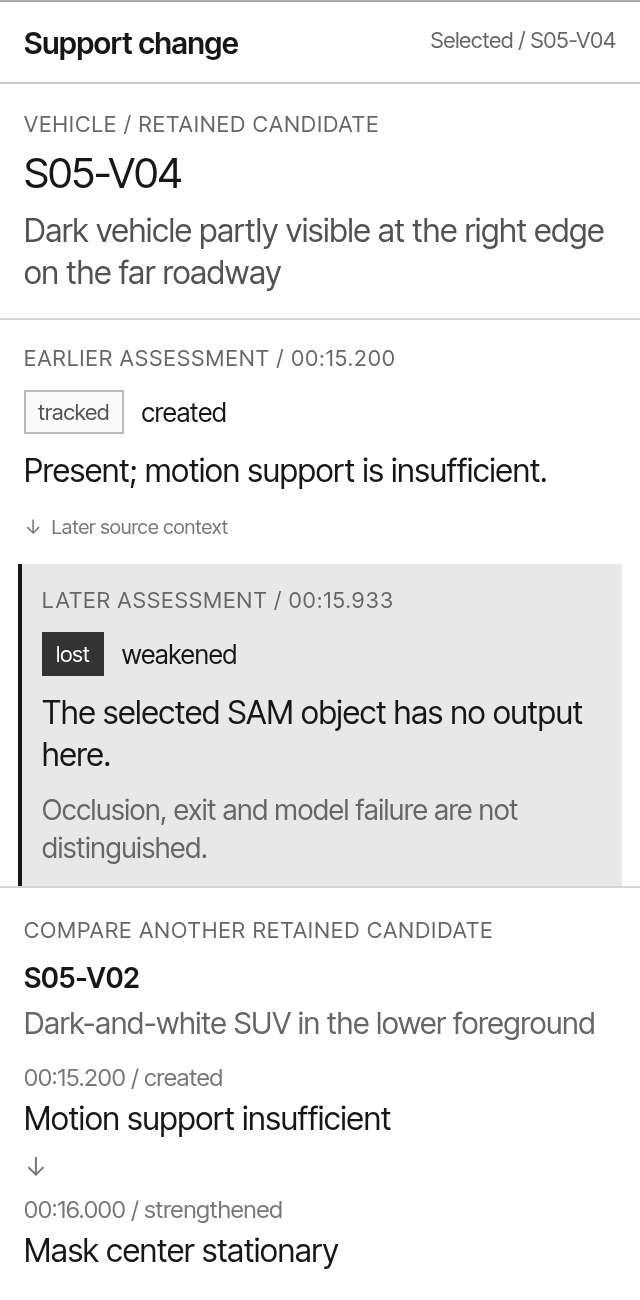
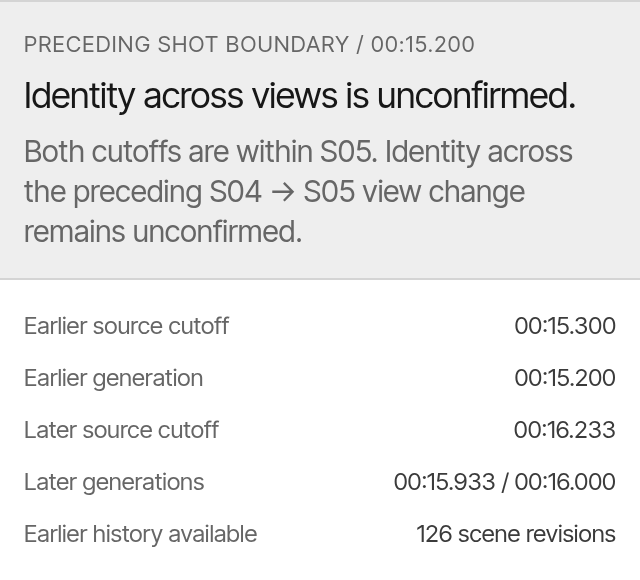
Compare retained S05 records at source 00:15.300 and 00:16.233. Indicant preserves the earlier basis while showing which assessments gained support, which weakened, and where identity remains unconfirmed.
Open the complete workspace imageRead the evidence summary
Follow support as the situation changes
- Boundary and retained scene history
- At source 00:15.300 the register contains five tracked S05 records and 126 scene assessment revisions are available. The 00:15.200 scene assessment marks a shot boundary and leaves identity across views unconfirmed.
- Selected change in support
- S05-V04 is tracked in the earlier register, with a created assessment at 00:15.200 and insufficient motion support. At source 00:16.233 it is lost, with its assessment weakened at 00:15.933 because the selected object has no output.
- Support that remains
- S05-V02 is tracked in both source views. Its earlier visible assessment is created at 00:15.200 with insufficient motion support; later it has no material screen-space displacement and its assessment is strengthened at 00:16.000.
- Earlier context remains distinguishable
- The retained 00:15.133 and 00:15.100 scene assessments report seven tracks needing review before the new view. The boundary does not establish that differently named candidates across those views share an identity.
Indicant informs operational judgment. Decisions and command authority remain with the responsible people and systems.
03 / Put Indicant to work
Evaluate Indicant on an operational question
Choose a question your team needs to answer. Compare the assessments Indicant generates, the evidence it connects, and the changes it surfaces against the way your team establishes the basis for a decision.
Start with one operational question, authorized evidence, and a named decision owner.